pass, ID, passport and connected issues

The following terms

  • pass,
  • ID,
  • passport,
  • obligation of identification and
  • obligatoin to carry

are quite often confused, mixed up or misunderstood. Let’s fix that:

pass

A “pass” can be any random document. For example a video-rental-shop-pass, bus pass, etc… The word has no official meaning. Everybody is allowed to invent and/or issue passes of all kind, for example a member pass for the “I-have-the-cuddliest-teddybear-ever”-club.

ID

An ID is a sovereign document which some countries issue to their citizens for identification purposes. An EU-issued ID grants entry to all EU-countries, as well as a limited amount of third countries. Most EU countries issue IDs in credit card format.

passport

A passport has, mainly, the same purpose as an ID. However it takes the form of a small booklet and is thus much less practical to carry. The empty pages provide space for endorsements by other countries, in most cases Visas and Entry- Exit stamps. When traveling to non-EU countries, a passport can be obligatory. Most well-known example: the United States of America.

obligation of identification

At least in Germany, the “obligation of identification” provides that every person in Germany is obliged to possess an ID or passport. If you don´t know the difference between possession and property I recommend to find out about the difference in detail(!). Let me say this much: Most people cannot call an ID or passport their property, since most issuing states will remain the proprietor. However, everybody whose ID/passpoer is laying around at home or in some hotel room is officially in its possession. In the UK, for example, no one is obliged to possess anything. Nevertheless, since no-one can leave (or re-enter) the UK without a passport, most UK citizens possess a passport anyway.

obligation to carry

An “obligation to carry” is in effect, when everybody is obliged to carry a specific document with them at all times. In (examples) Germany, Switzerland and the UK no-one is obliged to carry anything with them. Everyone is allowed to just walk around “as is”. However, if police wants to check someone it´s better if you can identify yourself by an official document, as otherwise they are allowed to take the individual with them for identification purposes. No fine or punishment would apply for not carrying official ID. Exceptions to the rule: When crossing a Schengen-border, everybody must be able to produce official identification. As such, when crossing borders, an “obligation to carry” applies throughout the Schengen-area. In (for example) the Netherlands and Belgium an “obligation to carry official ID” is in effect everywhere and at all times.

Exceptions:

Every rule has its exceptions. Not everyone in Germany must possess an ID, and under certain circumstances even a person in Germany or Switzerland must carry ID at all times. These exceptions are usually of no importance to normal citizens, especially as you will be made aware of these rules should they apply to you. Examples include if you’re in prison (no obligation to possess an ID), or if you have a license to carry a gun (when carrying a gun you´re obliged to also carry ID + the gun license).
SBB and their “via” choices

If you want to buy a ticket with the Swiss train service (SBB), you´d better already know the Swiss map and SBB’s tariff regulations in great detail. Otherwise you might unwittingly become a fare dodger.

Imagine you arrive at Zürich Airport without local knowledge, and want to visit someone in Uster (the suburb in which I happen to live):

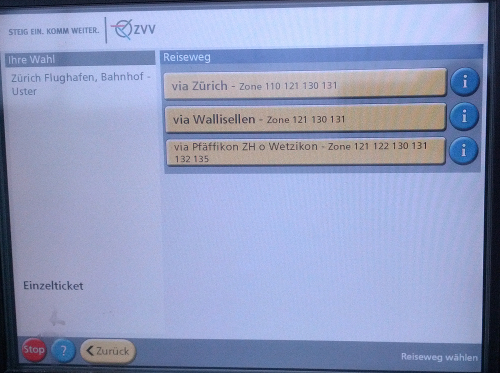
From “Zürich Airport” to “Uster” the vending machine will present you with the following options:

AuswahlHow to chose the correct “via”? From a logical perspective anyone could assume “the less zones the cheaper” so I´ll best go “via Wallisellen” if I´m not in a rush. While that´s not always true, in this specific case it is (cheaper but slower…).

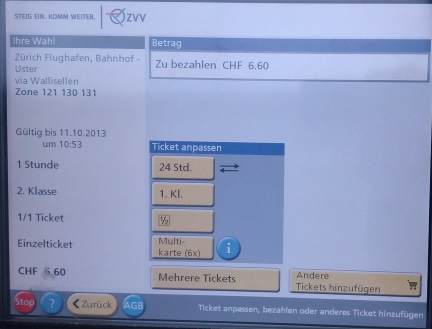
If you chose “via Wallisellen” the last thing to do is pay:

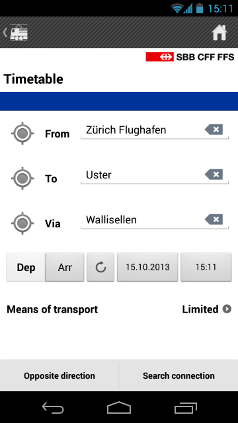
2_zusammenfassungYou, the latest SBB-customer (aka fare dodger), now have a ticket “Zürich Airport” to “Uster” “via Wallisellen”. You copy these details, 1:1, into the prepared SBB-Mobile-App to find a corresponding connection:

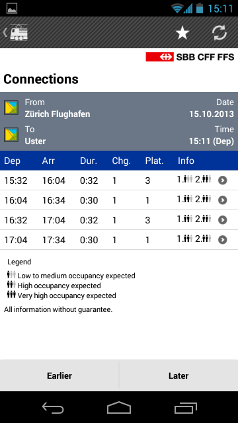
1_eingabeAll listed connections must be “via Wallisellen”, since that´s what you entered, right?

2_verbindungen

you just chose the next available one, leaving 15h32:

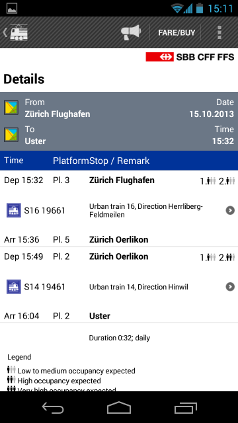
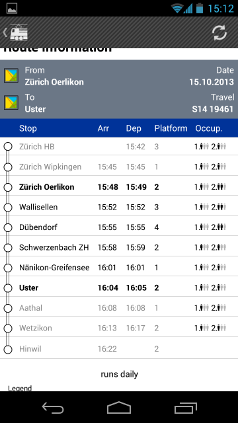
3_AuswahlIf you pay detailed attention you´ll be surprised: Change in Oerlikon?! Where is Wallisellen? So you go into the details and find the details as per below:4_Detail Wallisellen does appear, so this connection actually takes us “via Wallisellen”.

Still weary that something might be wrong you check all(!) other connections. They´re all the same – it´s always via Oerlikon (and also via Wallisellen). So you assume all is good…


If you´re not checked you´ll never know. However, if you are checked, you have to pay CHF 100 fine as a “fare dodger”. Reason: Oerlikon is already in Zürich’s “110”-Zone, the one we wanted to circumvent. The catch is that the vending machines and the SBB-Mobile-App handle connections differently. The vending machine looks at used zones in theoretically possible connetions. The SBB-App looks for “fastest connections”, where “passing through” counts as “via”.

If you want buy the proper ticket, you´ll have to know which connection passes through which zones. Something that is nearly impossible, especially for tourists.

SEPA

The newly introduced “Single European Payment Area” (SEPA) has a huge problem with its basic definition: The IBAN/BIC account number.

The IBAN (=International Bank Account Number) was supposed to be usable for €uro-wide transfers as well as direct debits. The creators of the SEPA-system have, unfortunately, not introduced truly uniform new €uro-wide account numbers.

Account numbers have merely been converted into a uniform format using their former constituent parts. Example for Germany:

Existing account:
account: 1234567890
sort code: 87654321

changed into:
IBAN: DE12876543211234567890
(where “DE” indicates the country, followed by 2 checksum digits, then the former sort code, and the old account number)

Details on all participating countries can be found on >>Wikipedia<<.

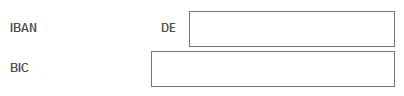
The problem is that the country can be immediately identified. As a consequence there are now forms which thwart the international purpose of the SEPA by requiring account numbers to start with “DE”. As an example see the online form of a German mobile phone operator:

IBAN-BIC-Maske

Technically banks now allow €uro-wide direct debits, but the faulty implementation ensures that customers can´t use this feature.

ebay feedback system

The feedback system is the core of what makes ebay run.

feedback –> trust –> business

—  vs.  —

no feedback –> no trust –> no business

Hence it´s in ebay´s own interest to keep fraud low and overall feedback positive. However, in their quest to achieve this, ebay overshots the mark:

How does the feedback-system work today?

  • member 1 (consumer) buys stuff from member 2 (vendor)
  • both consumer and vendor can then give their feedback

What´s the problem?

Whoever replies first loses out: The second party can base their opinion on the first party´s feedback.

As long as both are positive about the transaction, this is not a problem. But once you want to complain about someone… Will you really do it? Or will you refrain from giving negative feedback, because you are afraid that the other party might retaliate? Gotcha!

Many vendors turn this into a virtue: Check ebay for phrases such as “We only give feedback after we receive your feedback”. Most intriguing.

What could a solution be?

Once one party gives feedback, the other party should simply see a flag “feedback for transaction available” – but it shouldn´t reveal what the feedback is. Once the second party entered their feedback, both replies should irrevocably appear. No retaliation possible.

Of course, you say, most vendors know when a consumer isn´t happy. Such things usually have a “story” – thus the vendor can block “potentially” negative feedback by just not providing feedback. That´s where the second element comes into play:

After a specific deadline, all feedback given by any party should appear, but exactly from the same second it should no longer be possible to provide counter-feedback. Again: retaliation impossible.

Why doesn´t ebay want this?

At present, practically all ebayers have positive percentages between 99.0 and 99.9%. Everything below 99 is deemed unacceptable by consumers, so ebay needs to keep these values up. Otherwise, they fear, overall sales (and thus commissions) would go down.

However, if this suggestion changes the feedback culture towards a new scenario where 90% positive is deemed “good” and 95% “excellent”, consumers would finally have a real and reliable number to base their purchasing decision on. Rotten apples are filtered early on, as consumers can finally say what they really think. Replacing the current “friendly crap”.

Rates @ deutsche Post

European postal services, in cooperation with the European “Union”, remain a mystery to me. Sending packages throughout Germany/the EU highlights how national borders can still cause totally illogical outcomes.

Let´s compare: We want to send a fairly standardised package of 45/30/15cm and 2kg.

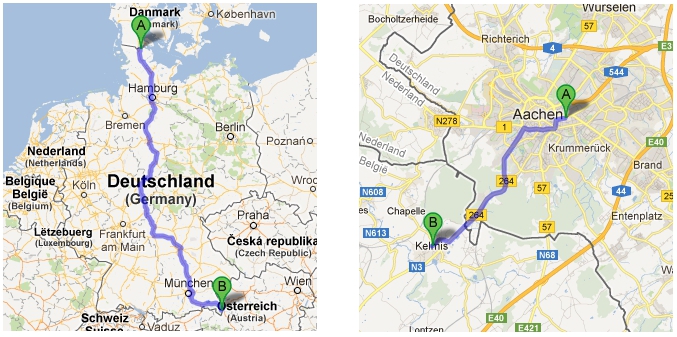
From Flensburg to Berchtesgaden                    From Aachen to Kelmis
(=within Germany)                                              (from Germany to Belgium)

A2K+F2B

>>map<< — click for — >>map<<
1092 km — distance — 10.4 km
10h20 — time to drive — 00h13
€ 4.10 — usual price — € 8.90

While the domestic package travels 10000% farther, and driving the distance by car would take 5000% longer, this very package is still ~50% cheaper.

Official reason:The international transport involves two companies, namely the German and Belgian postal services, while the domestic shipment is exclusively handled by one company. Please judge yourself how much sense this makes to you!

North Korea

I heard so much about NorthKorea, so in April 2011 I though: Go and see for yourself!

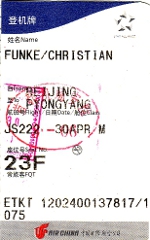
boarding pass

The only way to get there from Europe is via Beijing. A friend had set up base in Beijing, so I took this as a sign that I should go right now…

A few days later I found myself in a group, checking into a flight with Air Koryo (North Korean national airline) from Beijing to Pyongyang.

What was about to come, was the oddest journey of my life.

On arrival in Pyongyang, our group was picked up by our “guides”. These guides would stay with us 24/7 – the whole lenght of our stay. The complete itinerary is set in stone before tourists arrive.